SRSKA ARTICLE
Author – Mani Akella
October 02, 2026
The Carnatic melakarta system and Bhatkhande’s thaat system, set side by side and then layered, one over the other
Picture two students at the same music academy. One sings Mayamalavagowla, the first raga of the Carnatic lessons. The other sings Bhairav, a raga that opens many Hindustani mornings. Held side by side, the two scales turn out to be identical, note for note. Yet the first student speaks of melakarta number 15, and the second of a raga that belongs to the Bhairav thaat. The sound is the same. The names, the family trees, and even the hours of the day at which each raga is traditionally sung come from two different ways of thinking.
Both great traditions of Indian classical music grew from the same ancient root, and both faced the same practical problem: with hundreds of ragas in living use, how can a learner find order among them? The Carnatic answer, the 72 melakartas, was reached by logic and arithmetic. The Hindustani answer, the ten thaats of Pandit Vishnu Narayan Bhatkhande, was reached by observing what musicians actually sang. This article sets the two answers side by side, lays one over the other like a transparency, and tests the result against twenty-eight ragas. Along the way it explains how the Hindustani time-of-day cycle works, what that cycle means for Carnatic music, and why the Carnatic “vivadi” notes, a product of naming rather than of sound, make no difference at all to what the ear hears.
At a glance
• Both systems rest on the same twelve pitches in the octave. They differ in how those pitches are named and grouped.
• Melakarta: 72 parent scales produced by one rule. Each is a complete raga, and thousands of ragas are born from them.
• Thaat: 10 parent scales that Bhatkhande selected from 32 possible patterns, used to classify ragas by resemblance.
• 32 of the 72 melakartas match the 32 possible thaat patterns exactly. The other 40 use “vivadi” names, which are alternate names for pitches that Hindustani music already has.
• Bhatkhande’s ten thaats sit at melakarta numbers 8, 15, 20, 22, 28, 29, 45, 51, 53 and 65.
• In Hindustani music, time of day is part of a raga’s identity. Carnatic music keeps looser but real associations, and the scale match makes it possible to carry the Hindustani clock across.
§01 The Carnatic System: Melakarta
A scale-factory built on one rule
The word melakarta joins mela (a scale, literally a meeting of notes) and karta (a maker or parent). A melakarta is a scale from which other ragas, called janya ragas, are born. Three conditions define it. It must be sampurna, containing all seven notes. Its ascending and descending forms must use exactly the same notes in strict order. And it must contain Sa and Pa together with exactly one variety each of Ri, Ga, Ma, Dha and Ni, taken in the order of their letters. A melakarta is more than a scale on paper: each one is a full raga in its own right, and several of them, such as Sankarabharanam, Kalyani, Todi and Kharaharapriya, are among the most celebrated ragas in concert.
Twelve pitches, sixteen names
Carnatic theory recognizes twelve pitch positions in the octave. Sa and Pa never change. Ma has two forms, shuddha (M1) and prati (M2). Each of Ri, Ga, Dha and Ni has three named forms, numbered 1, 2 and 3. Because one pitch can carry two names, sixteen names rest on twelve pitches: the pitch of Chatushruti Rishabha (R2), for example, is also the pitch of Shuddha Gandhara (G1). Section 04 returns to this overlap, which matters a great deal for the comparison with Hindustani music.
The building rule
Once the names are fixed, the 72 melakartas fall out of a simple multiplication. Ri and Ga can be combined in six ways (R1G1, R1G2, R1G3, R2G2, R2G3, R3G3), because Ri must come before Ga and the two cannot share a name. Dha and Ni can be combined in the same six ways. With two forms of Ma, the total is 2 × 6 × 6 = 72.
Table 1 · The twelve chakras (“wheels”) of the melakarta scheme
| No. | Chakra | Melakarta numbers | Ma | Ri–Ga pair |
| 1 | Indu | 1–6 | M1 | R1 G1 |
| 2 | Netra | 7–12 | M1 | R1 G2 |
| 3 | Agni | 13–18 | M1 | R1 G3 |
| 4 | Veda | 19–24 | M1 | R2 G2 |
| 5 | Bana | 25–30 | M1 | R2 G3 |
| 6 | Rutu | 31–36 | M1 | R3 G3 |
| 7 | Rishi | 37–42 | M2 | R1 G1 |
| 8 | Vasu | 43–48 | M2 | R1 G2 |
| 9 | Brahma | 49–54 | M2 | R1 G3 |
| 10 | Disi | 55–60 | M2 | R2 G2 |
| 11 | Rudra | 61–66 | M2 | R2 G3 |
| 12 | Aditya | 67–72 | M2 | R3 G3 |
Within each chakra, the Ri–Ga pair stays fixed while the Dha–Ni pair steps through its six combinations in order: D1N1, D1N2, D1N3, D2N2, D2N3, D3N3. The first 36 melakartas use M1 and the last 36 use M2. As a result, mela n and mela n + 36 are twins that differ only in Ma. Mela 29 and mela 65 are one such pair; mela 20 and mela 56 are another.
Decoding a melakarta number: mela 29
Mela 29 lies between 1 and 36, so Ma is M1. It falls in the fifth chakra (Bana, melas 25–30), where the Ri–Ga pair is R2 G3. It is the fifth mela inside that chakra, so the Dha–Ni pair is the fifth in the list, D2 N3. The scale is S R2 G3 M1 P D2 N3, which is Dheerasankarabharanam.
Names that carry their own numbers
The names of the melakartas are built so that the number can be recovered from the name. The Katapayadi formula assigns a digit to each Sanskrit consonant. The first two consonants of a mela name, read as digits and then reversed, give the mela number.
- Dheera-Shankarabharanam: dha = 9, ra = 2, giving 92, reversed to 29.
- Maya-Malavagowla: ma = 5, ya = 1, giving 51, reversed to 15.
- Khara-Harapriya: kha = 2, ra = 2, giving 22, which stays 22.
- Mecha-Kalyani: ma = 5, cha = 6, giving 56, reversed to 65.
- Kanakangi: ka = 1, na = 0, giving 10, reversed to 01, the first mela.
How the scheme came to be
The idea of grouping ragas under parent scales developed over centuries. Ramamatya (Svaramelakalanidhi, 1550) described a scheme of about twenty melas, and Somanatha (Ragavibodha, 1609) widened the idea of a scheme of melas. The decisive step came from Venkatamakhin, working at the Nayak court of Thanjavur in the mid-seventeenth century (the Chaturdandi Prakashika is dated between about 1650 and 1660). He saw that the possible scales could be counted: choose one form of each variable note, and exactly 72 scales result. Only 19 of those scales were in active use in his time. The remaining 53 were logical possibilities that musicians might one day bring to life. Later, Govindacharya (Sangraha Chudamani, around the turn of the nineteenth century) gave the scheme the regular, mathematical shape that is taught today, and the Katapayadi-based names in common use grew out of that tradition. The Dikshitar school kept an older set of names for some melas, which is why a few ragas appear under two names in old books.
§02 The Hindustani System: Bhatkhande’s Thaats
A frame built from the ragas musicians actually sang
The word thaat means a frame or structure, and it is traditionally linked to the arrangement of frets on a sitar or veena, the frame on which the notes are set. A thaat is a parent scale from which ragas are classified. The scheme was designed by Pandit Vishnu Narayan Bhatkhande (1860–1936), a scholar born in Bombay who studied the old Sanskrit treatises and then traveled across India, meeting court musicians and collecting compositions. Bhatkhande took the Carnatic melakarta scheme as his model and adapted it to the music he found in the north.
Twelve pitches, twelve names
Hindustani naming is simpler on the surface. The octave has twelve pitches and twelve names. Sa and Pa are fixed. Re, Ga, Dha and Ni each have a natural (shuddha) form and a flat (komal) form. Ma has a natural form and a sharp (tivra) form.
The rules of a thaat
Bhatkhande set down a few firm rules. A thaat has seven notes, with one form of each. It is described in ascending order only. It is a frame for classification rather than something to be performed, although each thaat takes the name of a well-known raga. Because five notes (Re, Ga, Ma, Dha, Ni) can each take two forms, the rules allow 2⁵ = 32 possible thaats. Bhatkhande chose ten, the ones prominent in the music of his day. His writings do not state a single formula for choosing exactly those ten, which is why scholars still discuss the question.
Table 2 · The ten thaats
| Thaat | Notes | Western cousin |
| Bilawal | S R G M P D N | Ionian (major) |
| Khamaj | S R G M P D n | Mixolydian |
| Kafi | S R g M P D n | Dorian |
| Asavari | S R g M P d n | Aeolian (natural minor) |
| Bhairavi | S r g M P d n | Phrygian |
| Bhairav | S r G M P d N | Double harmonic (Byzantine) |
| Kalyan | S R G M♯ P D N | Lydian |
| Marwa | S r G M♯ P D N | — |
| Purvi | S r G M♯ P d N | — |
| Todi | S r g M♯ P d N | — |
Capital letters are natural (shuddha) notes, lowercase letters are komal (flat) notes, and M♯ is tivra Ma.
The thaat is a filing system, so ragas are filed by resemblance. A raga that lacks some notes, or borrows from two scales, is placed in the thaat it most resembles. Bhoopali, which has no Ma at all, is filed under Kalyan, and some ragas can be placed only by judgment of feel. Ragas that Hindustani music later borrowed from the Carnatic tradition often sit outside the thaat scheme altogether.
What came before
Before Bhatkhande, many Hindustani teachers organized ragas as families: a handful of principal ragas, each with “wives” (raginis) and “sons”, a scheme pictured in the Ragamala paintings of the sixteenth to nineteenth centuries. The family tree was poetic but hard to apply to scales. Bhatkhande replaced it with a classification that a student could test with the ear and a harmonium. His case for the ten thaats is made in his four-volume Hindustani Sangeet Paddhati, written in the early twentieth century, and he worked to put the system into schools through music conferences and the colleges he helped to establish.
Table 3 · A timeline of the two systems
| When | What happened |
| c. 200 BCE – 200 CE | The Natyashastra sets out the 22 shrutis and the scale families of the ancient system, the shared root of both traditions. |
| 13th century | Sarngadeva’s Sangita Ratnakara, a major text that both traditions claim as their own. |
| 1550 and 1609 | Ramamatya and Somanatha develop the idea of grouping ragas under melas. |
| c. 1650–1660 | Venkatamakhin’s Chaturdandi Prakashika establishes the 72-mela scheme. |
| c. 1800 | Govindacharya’s Sangraha Chudamani regularizes the 72 melakartas. |
| 1860–1936 | Life of Pandit Vishnu Narayan Bhatkhande, who researches across India from about 1907 to 1909. |
| Early 20th century | Hindustani Sangeet Paddhati presents the ten-thaat classification. |
§03 Side by Side: The Comparison
Same destination, two routes
Set next to each other, the two systems show a clear pattern. The Carnatic scheme is generative: it states a rule and lets every scale that the rule allows come into being, whether or not any musician has sung it yet. The Hindustani scheme is descriptive: it starts from the music and chooses the frames that cover it.
Table 4 · Melakarta and thaat compared
| Feature | Melakarta (Carnatic) | Thaat (Hindustani) |
| Purpose | Parent scale and a complete raga in its own right | Classification frame, usually an abstract scale |
| How it was built | By arithmetic: every combination the rule allows | By observation: ten scales chosen from 32 possible |
| Number | 72 (2 × 6 × 6) | 10 chosen from 2⁵ = 32 |
| Note names | 16 names on 12 pitches (three forms each of Ri, Ga, Dha, Ni) | 12 names on 12 pitches (komal, shuddha, tivra) |
| Ascent and descent | Same notes, in strict order, both ways | Defined in ascent only; ragas may differ in descent |
| Children | Janya ragas: fewer notes, zigzag (vakra) paths, occasional foreign notes (bhashanga) | Ragas filed by resemblance; blends of two thaats are common |
| Naming | Katapayadi names that encode the mela number | Thaat takes the name of its best-known raga |
| How a raga is recognized | Arohana and avarohana, gamakas, characteristic phrases | Pakad (signature phrase), vadi and samvadi, chalan, time of day |
| Time of day | Associations exist but are loose | Part of the raga’s identity (see §06) |
The two schemes also reflect two views of what a scale is. A Carnatic mela is a named, numbered, performable raga that sits at a fixed position in a grid. A Hindustani thaat is a frame of reference. A student can sing Kalyani in concert as a raga, but nobody performs “Kalyan thaat” as such; the performance would be Yaman, Bhoopali, Kedar or another raga that the thaat covers.
When the same name means different music
• Carnatic Todi (Hanumatodi, mela 8) has the notes of Hindustani Bhairavi. The Hindustani Todi has the notes of Carnatic Subhapantuvarali (mela 45).
• Carnatic Bhoopalam (S R1 G2 P D1) matches the Hindustani Bhupal Todi. The Hindustani Bhoopali matches the Carnatic Mohanam.
• Carnatic Bhairavi is a different raga from Hindustani Bhairavi; the Carnatic raga sits closer to the Hindustani Asavari.
• Several pairs share a scale under different names: Kalyani = Yaman, Mayamalavagowla = Bhairav, Sankarabharanam = Bilawal, Kharaharapriya = Kafi, Harikambhoji = Khamaj, Natabhairavi = Asavari, Hindolam = Malkauns, Abheri = Bhimpalasi.
§04 The Vivadi Question
Extra names, not extra sounds
The Carnatic system has sixteen swara names for twelve pitches. Four of those names are called vivadi: Shatshruti Rishabha (R3), Shuddha Gandhara (G1), Shatshruti Dhaivata (D3) and Shuddha Nishada (N1). Each of them is a second name for a pitch that already has another Carnatic name. The table below lays the names against the pitches.
Table 5 · Twelve pitches, sixteen Carnatic names, twelve Hindustani names
| Semitones above Sa | Carnatic name(s) | Hindustani name |
| 0 | Shadja (Sa) | Sa |
| 1 | Shuddha Rishabha (R1) | Re komal |
| 2 | Chatushruti Rishabha (R2) = Shuddha Gandhara (G1) | Re |
| 3 | Shatshruti Rishabha (R3) = Sadharana Gandhara (G2) | Ga komal |
| 4 | Antara Gandhara (G3) | Ga |
| 5 | Shuddha Madhyama (M1) | Ma |
| 6 | Prati Madhyama (M2) | Ma tivra |
| 7 | Panchama (Pa) | Pa |
| 8 | Shuddha Dhaivata (D1) | Dha komal |
| 9 | Chatushruti Dhaivata (D2) = Shuddha Nishada (N1) | Dha |
| 10 | Shatshruti Dhaivata (D3) = Kaisiki Nishada (N2) | Ni komal |
| 11 | Kakali Nishada (N3) | Ni |
The four vivadi names are in bold.
Why the names exist
The vivadi names are a consequence of the building rule. Every melakarta must contain exactly one note for each letter of Sa, Ri, Ga, Ma, Pa, Dha, Ni, in order. Suppose a scale takes the two pitches that lie one and two semitones above Sa. Both fall in the “Ri” zone, so the rule requires one to be called Ri and the second to be called Ga. The second pitch therefore becomes Shuddha Gandhara (G1), a name that exists to keep the grammar of the scheme intact. The same reasoning produces R3 when a scale holds the pitches three and four semitones above Sa, and likewise for Dha and Ni. The names are an artifact of the system, which is what makes them artificial in the sense of being devised rather than heard.
Why they do not change the music
A singer sings pitches, and the four vivadi names land on pitches that the Hindustani system already names without any difficulty.
- Shuddha Gandhara (G1) is the pitch of Re.
- Shatshruti Rishabha (R3) is the pitch of Ga komal.
- Shuddha Nishada (N1) is the pitch of Dha.
- Shatshruti Dhaivata (D3) is the pitch of Ni komal.
Take the two extreme examples. Kanakangi (mela 1) is written S R1 G1 M1 P D1 N1. Read as pitches, it is Sa, komal Re, Re, Ma, Pa, komal Dha, Dha. Chalanata (mela 36) is written S R3 G3 M1 P D3 N3, and as pitches it is Sa, komal Ga, Ga, Ma, Pa, komal Ni, Ni. Every note in both scales is an ordinary Hindustani note. The only thing that Hindustani naming cannot do is describe such a scale as a thaat, because a thaat must carry one form of each letter and these scales carry two Res or two Gas. Hindustani music itself has no difficulty with two forms of one note in a single raga: Bahar, for example, uses both komal and shuddha Ni.
The counting works out neatly. Of the 72 melakartas, 32 contain no vivadi name, and those 32 are exactly the 32 scales that Bhatkhande’s rules permit. The other 40 contain at least one vivadi name. Four whole chakras (Indu, Rutu, Rishi and Aditya, 24 melas) are vivadi throughout, and in each of the eight other chakras the first and last mela (D1N1 and D3N3) add two more, giving 24 + 16 = 40. In everyday concert practice, the parent ragas that most janya ragas hang from are mostly in the vivadi-free group, so the vivadi names rarely appear in the music a listener actually hears.
A word with two meanings
In Carnatic theory, a vivadi swara is one of the four overlapping swara names described above. In Hindustani theory, vivadi is a different idea: it is the “enemy” note in a raga, a note that is avoided or touched very lightly, in the family of vadi (king), samvadi (minister), anuvadi (attendants) and vivadi. The two meanings have nothing to do with each other, and students who learn both traditions can keep them straight by remembering that one is a naming concept and the other is a melodic concept.
§05 Layering the Two Maps
Five transparencies on the same wheel
The comparison shows how the systems differ. Layering shows how they fit together. Imagine the 72 melakartas drawn as a wheel, numbered clockwise from Kanakangi at the top. The shuddha-Ma half (melas 1–36) fills the right side, and the prati-Ma half (melas 37–72) fills the left. Everything else in this article can be laid over that wheel as a transparent sheet.
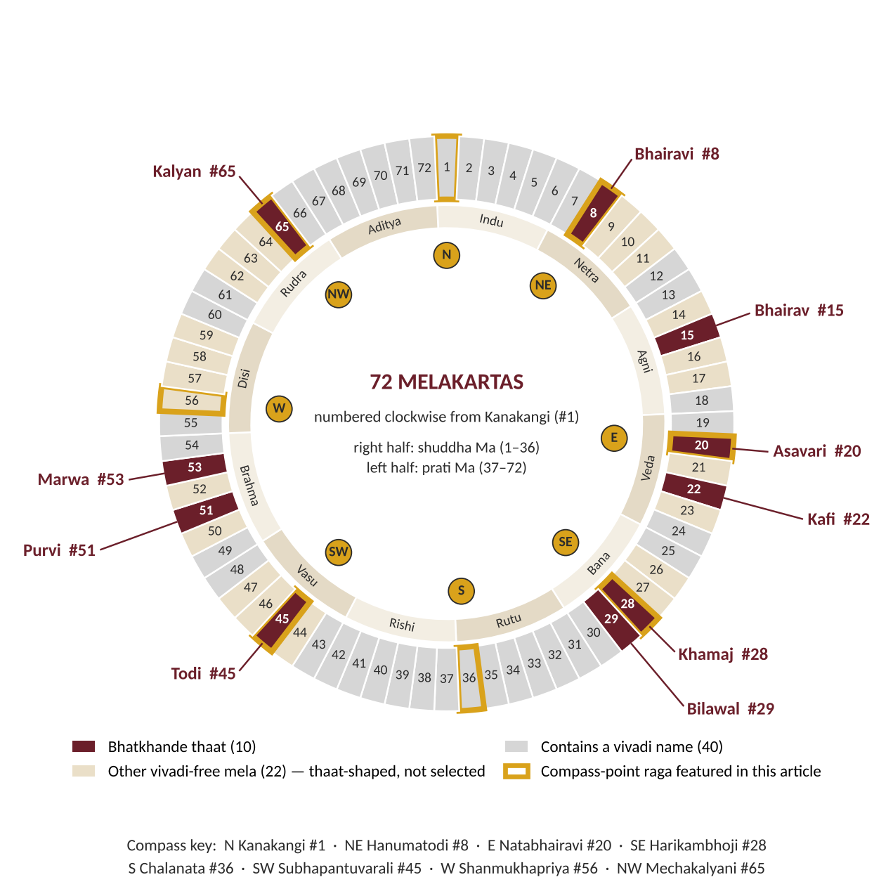
Figure 1 · The melakarta wheel, with the 32 vivadi-free melas, Bhatkhande’s ten thaats and the eight compass-point ragas of §07 marked.
Table 6 · The layers
| Layer | What it holds | Count |
| 0 · The shared pitch grid | The twelve pitches of the octave, common to both systems | 12 |
| 1 · The melakarta wheel | Every seven-note scale the Carnatic rule allows | 72 |
| 2 · Vivadi-free melas | Scales that Hindustani naming can describe with one form of each note | 32 |
| 3 · Bhatkhande’s selection | The ten thaats | 10 |
| 4 · Ragas and their hours | Janya ragas, raga members of each thaat, and the time-of-day cycle | open-ended |
The first three layers nest like boxes: ten thaats sit inside the 32 vivadi-free melas, and those sit inside the 72. Each thaat therefore has a single address on the Carnatic wheel.
Table 7 · The ten thaats at their melakarta addresses
| Thaat | Mela | Carnatic name | Chakra | Wheel position |
| Bhairavi | 8 | Hanumatodi (Todi) | Netra | NE |
| Bhairav | 15 | Mayamalavagowla | Agni | ENE |
| Asavari | 20 | Natabhairavi | Veda | E |
| Kafi | 22 | Kharaharapriya | Veda | ESE |
| Khamaj | 28 | Harikambhoji | Bana | SE |
| Bilawal | 29 | Dheerasankarabharanam | Bana | SE |
| Todi | 45 | Subhapantuvarali | Vasu | SW |
| Purvi | 51 | Kamavardhini (Pantuvarali) | Brahma | WSW |
| Marwa | 53 | Gamanashrama | Brahma | W |
| Kalyan | 65 | Mechakalyani (Kalyani) | Rudra | NW |
What the layering reveals
1. A sharpening ladder
Six of the ten thaats form a chain in which each step raises exactly one note. Starting from the all-flat Bhairavi and raising notes one at a time leads through Asavari, Kafi, Khamaj and Bilawal, and then through a raised Ma to Kalyan. On the wheel, that chain is the sequence of melas 8, 20, 22, 28, 29 and 65. Students familiar with Western modes will recognize it as the sequence Phrygian, Aeolian, Dorian, Mixolydian, Ionian and Lydian.
Table 8 · The sharpening ladder
| Step | Thaat | Mela | What changes | Western mode |
| 1 | Bhairavi | 8 Hanumatodi | Starting point: komal Re, Ga, Dha, Ni | Phrygian |
| 2 | Asavari | 20 Natabhairavi | Re komal → Re | Aeolian |
| 3 | Kafi | 22 Kharaharapriya | Dha komal → Dha | Dorian |
| 4 | Khamaj | 28 Harikambhoji | Ga komal → Ga | Mixolydian |
| 5 | Bilawal | 29 Dheerasankarabharanam | Ni komal → Ni | Ionian |
| 6 | Kalyan | 65 Mechakalyani | Ma → Ma tivra | Lydian |
2. Two corners and a set of twins
Inside the shuddha-Ma half, the grid of 16 vivadi-free melas has two opposite corners. Hanumatodi (mela 8, Bhairavi) is the all-flat corner and Dheerasankarabharanam (mela 29, Bilawal) is the all-natural corner. Kalyan then sits exactly opposite Bilawal, because Mechakalyani (mela 65) is the prati-Ma twin of mela 29: the two are 36 steps apart, half a turn of the wheel.
3. Where the thaats live, and where they do not
Only seven of the twelve chakras contain a thaat (Netra, Agni, Veda, Bana, Vasu, Brahma and Rudra). Four of the five empty chakras (Indu, Rutu, Rishi and Aditya) are entirely vivadi. The fifth, Disi, holds vivadi-free melas such as Shanmukhapriya, but Bhatkhande did not choose any of them. Those 22 vivadi-free melas that were not chosen (Appendix A lists all 32) are the Hindustani scales that exist in principle and that musicians can still use: Charukesi (mela 26), for instance, is a Carnatic mela that Hindustani music has adopted as the raga Charukeshi.
4. Same scale, different parent
The layers also show where the two systems file the same raga under different parents. The five notes of Bhoopali (Sa, Re, Ga, Pa, Dha) fit both Kalyan and Bilawal, since the missing notes are Ma and Ni, which are the notes that separate Kalyan from Bilawal. Bhatkhande filed it under Kalyan; Carnatic lists place the same scale, Mohanam, under Harikambhoji. Neither is wrong. When a raga drops the notes that distinguish two possible parents, each tradition decides by its own logic.
§06 The Hindustani Clock and Carnatic Music
How the time cycle works and what it means for the Carnatic ear
In Hindustani music, every raga has an hour. A raga performed at its proper time is believed to deepen its mood, and a performer who chooses a raga for a recital usually chooses it by the clock. This is the samay (time) theory of ragas. It has nothing to do with tala, the rhythmic cycle; the time involved here is the time of day.
The eight prahars
The day of twenty-four hours is divided into eight prahars of about three hours each: four for the day and four for the night. Twilight, when day passes into night and night into day, receives special attention, and the ragas of those two junctions are called sandhi prakash (“the light of the junction”) ragas.
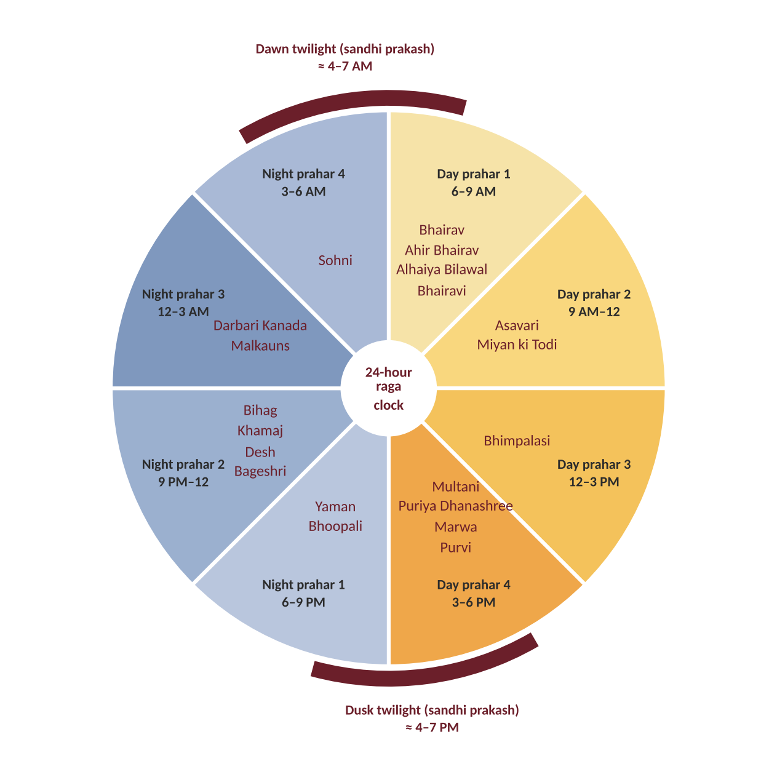
Figure 2 · The Hindustani raga clock, with the twenty ragas of §07. Sources differ by a prahar on some ragas, so the slots are traditional guides rather than fixed laws.
Four working rules
Pandit Bhatkhande popularized the modern form of the theory, and it is usually taught as a small set of rules.
- Twilight ragas (sandhi prakash). The ragas of dawn and dusk typically use komal Re, and often komal Dha as well, with natural Ga and Ni. Bhairav and Purvi follow the full pattern, and Marwa keeps the komal Re.
- Ma is the signpost. Among twilight ragas, a natural Ma points to dawn (Bhairav) and a tivra Ma points to dusk (Purvi and Marwa). Ma is sometimes called the adhvadarshak swara, the note that shows the direction of the hour.
- Where the vadi lies. The octave splits into a lower half (Sa to Ma) and an upper half (Pa to Ni). As a general tendency, a raga whose vadi (principal note) lies in the lower half belongs to the hours from noon to midnight, and a raga whose vadi lies in the upper half belongs to the hours from midnight to noon. Yaman, with Ga as its vadi, is an evening raga, and Bhairav, with Dha as its vadi, is a dawn raga. Several night ragas sit at the edge of the rule, so it is a tendency, not a law.
- Season. Some ragas belong to seasons as well as hours. The Malhar family is linked to the monsoon, and Basant to spring.
Where the idea comes from
The link between music and the rhythms of nature is old. Ancient Tamil poetics tied each of its five landscapes to a melodic mode (a pann) and to particular seasons and hours, which shows that a time theory was present in the southern tradition at its roots. Medieval Sanskrit treatises discuss suitable times for ragas, and the Ragamala paintings give each raga a season and an hour. Bhatkhande’s contribution was to gather the scattered customs into the eight-prahar scheme and to tie them to the notes of the scales through the rules above.
What the cycle means for Carnatic music
Carnatic music keeps the associations in a looser form. A concert is normally scheduled in the evening, so one program can include ragas that Hindustani convention would assign to dawn and to midnight. Even so, traditional habits remain strong. Ragas such as Bhoopalam and Bowli are linked with the hour before sunrise, Mayamalavagowla and Bilahari with the morning, Pantuvarali with twilight, and Neelambari with the night and the lullaby. Madhyamavati, which shares its scale with the Hindustani noon raga Madhmad Sarang, is customarily sung to close a concert, so its position in a concert is more of a ritual than a time of day.
The scale match between the two systems makes it possible to carry the clock across in a few steps. A Carnatic raga is identified, its mela is found, the Hindustani raga with the same scale is read off the wheel, and that raga’s place on the clock suggests an hour. The result is a suggestion rather than a rule, but it often agrees with Carnatic custom, and it gives a student a practical way to organize a day of practice.
Table 9 · The twenty ragas on the clock, with their Carnatic scale-siblings
| Hindustani raga (thaat) | Carnatic scale-sibling | Note |
| Day prahar 1 · 6–9 AM (dawn twilight begins around 4 AM) | ||
| Bhairav (Bhairav) | Mayamalavagowla, #15 | First scale of Carnatic lessons; a natural dawn raga to practice |
| Ahir Bhairav (Bhairav) | Chakravakam, #16 | Same scale; Carnatic lists it as a mela of its own |
| Alhaiya Bilawal (Bilawal) | Sankarabharanam, #29; Bilahari | Bilahari is often linked with the morning |
| Bhairavi (Bhairavi) | Hanumatodi (Todi), #8 | Hindustani Bhairavi often closes a recital; Carnatic Bhairavi is a different raga |
| Day prahar 2 · 9 AM–12 noon | ||
| Asavari (Asavari) | Natabhairavi, #20 | Same scale |
| Miyan ki Todi (Todi) | Subhapantuvarali, #45 | Not Carnatic Todi (Hanumatodi) |
| Day prahar 3 · 12–3 PM | ||
| Bhimpalasi (Kafi) | Abheri, janya of Kharaharapriya #22 | Same scale and the same parent family |
| Day prahar 4 · 3–6 PM (dusk twilight begins around 4 PM) | ||
| Multani (Todi) | Subhapantuvarali family, #45 | Its notes fit inside mela 45 |
| Puriya Dhanashree (Purvi) | Pantuvarali (Kamavardhini), #51 | Pantuvarali is often linked with twilight |
| Purvi (Purvi) | Pantuvarali (Kamavardhini), #51 | Same scale as Puriya Dhanashree |
| Marwa (Marwa) | Gamanashrama, #53 | Same scale family |
| Night prahar 1 · 6–9 PM | ||
| Yaman (Kalyan) | Kalyani (Mechakalyani), #65 | A favorite for evening alapana |
| Bhoopali (Kalyan) | Mohanam, janya of Harikambhoji #28 | Same five notes |
| Night prahar 2 · 9 PM–12 midnight | ||
| Bihag (Bilawal) | Behag | A raga both traditions share |
| Khamaj (Khamaj) | Harikambhoji, #28 (Kambhoji family) | Same scale family |
| Desh (Khamaj) | Desh | Both traditions have a Desh with a similar feel |
| Bageshri (Kafi) | Bageshri, janya of Kharaharapriya #22 | Same name, same scale, same parent |
| Night prahar 3 · 12–3 AM | ||
| Darbari Kanada (Asavari) | Scale of Natabhairavi, #20 | The slow oscillation of its flat notes is a cousin of kampita gamaka |
| Malkauns (Bhairavi) | Hindolam, janya of Natabhairavi #20 | Same five notes |
| Night prahar 4 · 3–6 AM | ||
| Sohni (Marwa) | Gamanashrama family, #53 | Same notes as Marwa, with a different emphasis |
Scale alone does not set the hour
The clock offers one more lesson. Two pairs of ragas in this article share the same notes and yet belong to different times. Bhoopali and Deshkar use the same five notes, but Bhoopali leans on Ga and sounds in the evening, while Deshkar leans on Dha and sounds in the morning. Marwa and Sohni use the same notes, but Marwa stresses the lower notes and belongs to sunset, while Sohni stresses the upper notes and belongs to the end of the night. The hour is therefore a property of emphasis. Carnatic music has its own vocabulary for the same idea in the weight given to a raga’s life notes (jiva swaras) and resting notes (nyasa swaras), which is one more reason why a student of one tradition understands the other more easily than might be expected.
A practice clock for Carnatic students
• Before sunrise and early morning: Bhoopalam, Bowli, Mayamalavagowla
• Morning: Bilahari, Sankarabharanam
• Twilight: Pantuvarali
• Evening: Kalyani, Mohanam
• Night: Hindolam, Neelambari
These pairings blend Carnatic custom with the Hindustani scale match. They are suggestions for building a habit of listening to the mood of the hour, and they are not rules of the tradition.
§07 Ragas on the Map
Twenty-eight ragas, each with an address in both systems
Eight Carnatic ragas around the wheel
The eight points of the compass on the wheel of Figure 1 fall on or beside melas 1, 8, 20, 28, 36, 45, 56 and 65. Each of those melas is a raga that Carnatic students know or will meet. Together they show the three situations that the layering describes: ragas that are thaats, ragas that are vivadi-free but were not chosen, and ragas that use vivadi names.
Table 10 · Eight compass points
| Point | Mela | Carnatic notes | Hindustani reading | Where it sits |
| N | 1 Kanakangi | S R1 G1 M1 P D1 N1 | Sa, komal Re, Re, Ma, Pa, komal Dha, Dha | Vivadi (G1, N1); no thaat |
| NE | 8 Hanumatodi | S R1 G2 M1 P D1 N2 | Sa, komal Re, komal Ga, Ma, Pa, komal Dha, komal Ni | Bhairavi thaat |
| E | 20 Natabhairavi | S R2 G2 M1 P D1 N2 | Sa, Re, komal Ga, Ma, Pa, komal Dha, komal Ni | Asavari thaat |
| SE | 28 Harikambhoji | S R2 G3 M1 P D2 N2 | Sa, Re, Ga, Ma, Pa, Dha, komal Ni | Khamaj thaat |
| S | 36 Chalanata | S R3 G3 M1 P D3 N3 | Sa, komal Ga, Ga, Ma, Pa, komal Ni, Ni | Vivadi (R3, D3); no thaat |
| SW | 45 Subhapantuvarali | S R1 G2 M2 P D1 N3 | Sa, komal Re, komal Ga, Ma tivra, Pa, komal Dha, Ni | Todi thaat |
| W | 56 Shanmukhapriya | S R2 G2 M2 P D1 N2 | Sa, Re, komal Ga, Ma tivra, Pa, komal Dha, komal Ni | Vivadi-free, not chosen |
| NW | 65 Mechakalyani | S R2 G3 M2 P D2 N3 | Sa, Re, Ga, Ma tivra, Pa, Dha, Ni | Kalyan thaat |
North · Kanakangi (mela 1)
Kanakangi is where the wheel begins, and it stacks the lowest form of every note. Its Carnatic names include the vivadi G1 and N1, so Hindustani naming would call it a scale with two Res and two Dhas and no Ga or Ni. It sits at North because it is the origin of the counting and the clearest picture of how naming, and not sound, produces a vivadi mela.
North-east · Hanumatodi (mela 8)
Hanumatodi is the first mela on the wheel that is free of vivadi names, and it takes the lowest allowed form of every variable note, which makes it the all-flat corner of the grid. In Hindustani terms it is the Bhairavi thaat. Carnatic students call it simply Todi, which is the first of the name swaps to watch for.
East · Natabhairavi (mela 20)
Natabhairavi is one step from Hanumatodi along the sharpening ladder: Re komal is raised to Re. It is the Asavari thaat. Across the wheel, at West, stands its prati-Ma twin, Shanmukhapriya (mela 56), so East and West are a matched pair that differ only in Ma.
South-east · Harikambhoji (mela 28)
Harikambhoji is Sankarabharanam with the Ni lowered, and it is the Khamaj thaat. Its position at South-east places it right next to Sankarabharanam (mela 29), the all-natural Bilawal corner, which is the picture of how close Khamaj and Bilawal are in sound.
South · Chalanata (mela 36)
Chalanata closes the shuddha-Ma half of the wheel. Its notes mirror Kanakangi: Kanakangi stacks the lowest forms and doubles Re and Dha, while Chalanata stacks the highest forms of Ri, Ga, Dha and Ni and doubles Ga and Ni. Its names include the vivadi R3 and D3. It sounds like Sa, komal Ga, Ga, Ma, Pa, komal Ni, Ni, which is a perfectly ordinary set of Hindustani notes that no thaat describes.
South-west · Subhapantuvarali (mela 45)
This is the Hindustani Todi thaat, with komal Re, komal Ga, tivra Ma, komal Dha and natural Ni. It differs from Hanumatodi in two notes (tivra Ma and natural Ni), which is why Hindustani Todi sounds so different from Carnatic Todi even though the names match. Its address on the wheel is the clearest reminder to check the notes before trusting the name.
West · Shanmukhapriya (mela 56)
Shanmukhapriya is vivadi-free, so Hindustani naming can describe it fully: Sa, Re, komal Ga, tivra Ma, Pa, komal Dha, komal Ni. It is one of the 22 patterns that belong to the 32 possible thaats but were not among the ten chosen. It is in Layer 2 and not in Layer 3.
North-west · Mechakalyani (mela 65)
Mechakalyani is the Kalyan thaat, and a Carnatic favorite known simply as Kalyani. It is the prati-Ma twin of Sankarabharanam (mela 29), exactly half a wheel away, and the Carnatic counterpart of Yaman.
Twenty Hindustani ragas, two for each thaat
Each thaat below is given with its melakarta address and two of its ragas. The “why here” line explains why the raga is filed where it is.
Bilawal
Mela 29 · Dheerasankarabharanam · Bana chakra · all natural notes: S R G M P D N
- Alhaiya Bilawal · morning. The thaat’s flagship raga, with weight on Dha and Ga. Carnatic cousin: Sankarabharanam, and Bilahari in particular. Why here: it uses the all-natural scale and is the plainest raga of the thaat.
- Bihag · night (9 PM to midnight). Natural notes with Ma tivra used as a touch. Carnatic cousin: Behag. Why here: its main notes are the all-natural scale of mela 29, but its tivra Ma reaches across to mela 65, the twin on the opposite side of the wheel.
Khamaj
Mela 28 · Harikambhoji · Bana chakra · S R G M P D n
- Khamaj · late evening. Natural Ni going up and komal Ni coming down, with a light and romantic mood. Carnatic cousin: the Kambhoji family. Why here: the komal Ni that characterizes its descent is exactly the note that separates mela 28 from mela 29.
- Desh · night (9 PM to midnight), with a monsoon association. Both forms of Ni appear. Carnatic cousin: Desh, which shares the name and the feel. Why here: same scale and the same two-Ni character as Khamaj.
Kafi
Mela 22 · Kharaharapriya · Veda chakra · S R g M P D n
- Bhimpalasi · afternoon. The ascent skips Re and Dha, and Ma is the vadi. Carnatic cousin: Abheri, a janya of Kharaharapriya. Why here: both systems agree on the parent, since Bhimpalasi and Abheri share a scale and a family.
- Bageshri · night. A soft raga that touches Pa only lightly. Carnatic cousin: Bageshri, also a Kharaharapriya janya. Why here: the notes and the parent are the same on both sides.
Asavari
Mela 20 · Natabhairavi · Veda chakra · S R g M P d n
- Asavari · late morning. The ascent omits Ga and Ni, while the descent uses the komal Ga, Dha and Ni. Carnatic cousin: Natabhairavi. Why here: it holds the full scale of mela 20 as its descent.
- Darbari Kanada · late night. A grave raga whose komal Ga and komal Dha are shaken with a slow oscillation (andolan). Carnatic cousin: the scale of Natabhairavi. Why here: same notes as Asavari, with a mood shaped by that oscillation, which is a cousin of the Carnatic kampita gamaka.
Bhairavi
Mela 8 · Hanumatodi · Netra chakra · S r g M P d n
- Bhairavi · early morning, but often sung last at any hour. All the variable notes are komal. Carnatic cousin: Hanumatodi, known as Todi. Why here: its scale is the all-flat corner of the vivadi-free grid. Carnatic Bhairavi is another raga entirely.
- Malkauns · midnight. Five notes (Sa, komal Ga, Ma, komal Dha, komal Ni), with no Re and no Pa. Carnatic cousin: Hindolam. Why here: Bhatkhande filed it under Bhairavi, while Carnatic lists place Hindolam under Natabhairavi (mela 20). The five notes fit both, so each system chose its own parent.
Bhairav
Mela 15 · Mayamalavagowla · Agni chakra · S r G M P d N
- Bhairav · dawn. Komal Re and komal Dha are shaken slowly with andolan. Carnatic cousin: Mayamalavagowla. Why here: it is the raga that gives the thaat its name, and the two scales are identical.
- Ahir Bhairav · early morning. Komal Re and natural Dha, with komal Ni, so two notes differ from Bhairav. Carnatic cousin: Chakravakam (mela 16). Why here: Bhatkhande filed it under Bhairav by resemblance, since it begins with the Bhairav pattern of komal Re and natural Ga, but the wheel puts its notes at mela 16, right next door.
Kalyan
Mela 65 · Mechakalyani · Rudra chakra · S R G M♯ P D N
- Yaman · the first prahar of the night, about 6 to 9 PM. Tivra Ma with Ga as the vadi and Ni as the samvadi. Carnatic cousin: Kalyani. Why here: it is the defining raga of the thaat.
- Bhoopali · early evening. Five notes (Sa, Re, Ga, Pa, Dha), with no Ma and no Ni. Carnatic cousin: Mohanam. Why here: the missing notes are the ones that separate Kalyan from Bilawal, so Bhatkhande filed Bhoopali under Kalyan, while Carnatic lists place Mohanam under Harikambhoji.
Marwa
Mela 53 · Gamanashrama · Brahma chakra · S r G M♯ P D N
- Marwa · sunset. Komal Re and tivra Ma, with Pa mostly omitted, and weight on the lower notes. Carnatic cousin: the scale family of Gamanashrama. Why here: it is the thaat’s defining raga, and its lower-note emphasis fixes it at dusk.
- Sohni · the end of the night, before dawn. The same notes as Marwa, with the weight on the upper notes. Carnatic cousin: the scale family of Gamanashrama. Why here: it shares the thaat with Marwa, and the shift of emphasis carries it to the opposite end of the clock.
Purvi
Mela 51 · Kamavardhini (Pantuvarali) · Brahma chakra · S r G M♯ P d N
- Purvi · dusk. Komal Re and komal Dha with tivra Ma. Carnatic cousin: Pantuvarali. Why here: the scale is the thaat itself, and Pantuvarali, a Carnatic raga associated with twilight, matches it note for note.
- Puriya Dhanashree · dusk. The same scale as Purvi with a prominent Pa. Carnatic cousin: Pantuvarali. Why here: two ragas on one scale, told apart by phrases and emphasis, which is why the thaat is a filing system and not a list of ragas.
Todi
Mela 45 · Subhapantuvarali · Vasu chakra · S r g M♯ P d N
- Miyan ki Todi · late morning. Komal Dha as the vadi and komal Ga as the samvadi, in a raga traditionally attributed to Miyan Tansen. Carnatic cousin: Subhapantuvarali. Why here: it is the defining raga of the thaat. The Carnatic raga with the same name, Todi, is mela 8 and sits in a different place.
- Multani · late afternoon. A Todi-thaat raga that brings in Re and Dha only on the way down. Carnatic cousin: its notes fit inside Subhapantuvarali. Why here: it relies on the same tivra Ma and komal Ga that mark the Todi pattern.
§08 What the Two Maps Teach
Respect for both, and a bridge between them
The two systems are not rivals. The melakarta wheel is a map of notes, built to be complete before a single raga is sung. The thaat scheme is a map of moods and hours, built from the music of its time. Laid over one another, they show that the traditions share one set of pitches, that most of what separates them is a matter of names, and that the real differences, such as gamaka, the weight of a note, and the hour of the day, are differences of artistry and not of notes.
For a student of either tradition, the layering is a practical gift. A Carnatic student who learns Yaman is learning Kalyani with a different heart and hour. A Hindustani student who meets Subhapantuvarali has met Todi. Understanding the bridge makes both sides richer, and it prepares a young musician to speak for the music in both languages, which is the work of a true ambassador of the culture.
Try this
- A student can sing the scale of Mayamalavagowla, then repeat it with the Hindustani names, Sa re Ga Ma Pa dha Ni, and listen for the identical pitches.
- A Carnatic raga that the student already knows can be traced to its mela number, and the Hindustani raga with the same scale can be found on Table 9.
- Bhoopali and Deshkar use the same five notes. Moving the emphasis between Ga and Dha in a short phrase makes the change of mood audible.
- A Carnatic raga can be practiced at the hour that the Hindustani clock suggests, with a note of whether the mood seems to fit.
Listening corner
Hearing the pairs one after another makes the match audible. The links below are YouTube recordings that students can find easily; they are suggestions and not endorsements of any particular rendition.
- Kalyani and Yaman: Raga Kalyani, Ramana Balachandhran · Raag Yaman, Varada Godbole
- Mayamalavagowla and Bhairav: Mayamalavagowla alapana and scale · Raag Bhairav description
- Hindolam and Malkauns: Raga Hindolam, Charulatha Mani · Hindolam and Malkauns jugalbandi
Quick glossary
| Term | Meaning |
| Swara | A musical note; the seven are Sa, Ri or Re, Ga, Ma, Pa, Dha, Ni. |
| Raga | A melodic framework with its own notes, phrases, mood and, in Hindustani music, hour. |
| Melakarta | One of 72 Carnatic parent scales, each a complete raga. |
| Janya | A raga derived from a melakarta. |
| Thaat | One of Bhatkhande’s ten parent scales used to classify Hindustani ragas. |
| Komal, shuddha, tivra | Flat, natural and sharp (tivra is used for Ma only). |
| Vadi, samvadi | The principal note of a raga and its supporting note (Hindustani). |
| Gamaka | An ornament that moves a note, central to Carnatic style. |
| Prahar | A three-hour period of the day in the Hindustani time theory. |
| Sandhi prakash | Twilight, the junction of day and night; also the ragas of that hour. |
| Katapayadi | A system that turns consonants into digits, used to encode mela numbers in names. |
Appendix A The Full Thirty-Two
Completing Bhatkhande’s grid, and why the old reasons for stopping at ten are wearing thin
Bhatkhande’s own rules allow 32 thaats, yet his scheme names only ten. This appendix completes the set, explains why the other 22 stayed unnamed for a century, and shows how the movement of Carnatic scales into Hindustani concerts has turned an old footnote into a practical question.
A.1 The complete set
The 32 arise from the same grid as before. Re, Ga, Dha and Ni each take a komal or a shuddha form, Ma takes a natural or a tivra form, and Sa and Pa stay fixed, so 2 × 2 × 2 × 2 × 2 gives 32 seven-note patterns. Every one of them is a vivadi-free melakarta, which means each has a ready address on the Carnatic wheel. The table lists them in order of mela number, with the ten thaats, two further patterns singled out below, and the remaining twenty.
Table A1 · All 32 possible thaat patterns, with their melakarta addresses
| Mela | Carnatic name | Hindustani notes | Test | Tier and known Hindustani use |
| 8 | Hanumatodi | S r g M P d n | Yes | Tier 1 · Bhairavi thaat |
| 9 | Dhenuka | S r g M P d N | No | Tier 3 |
| 10 | Natakapriya | S r g M P D n | No | Tier 3 |
| 11 | Kokilapriya | S r g M P D N | No | Tier 3 |
| 14 | Vakulabharanam | S r G M P d n | No | Tier 3 |
| 15 | Mayamalavagowla | S r G M P d N | Yes | Tier 1 · Bhairav thaat |
| 16 | Chakravakam | S r G M P D n | No | Tier 3 |
| 17 | Suryakantam | S r G M P D N | No | Tier 3 |
| 20 | Natabhairavi | S R g M P d n | Yes | Tier 1 · Asavari thaat |
| 21 | Keeravani | S R g M P d N | No | Tier 3 · Kirwani in Hindustani use |
| 22 | Kharaharapriya | S R g M P D n | Yes | Tier 1 · Kafi thaat |
| 23 | Gourimanohari | S R g M P D N | No | Tier 3 |
| 26 | Charukesi | S R G M P d n | No | Tier 3 · Charukeshi in Hindustani use |
| 27 | Sarasangi | S R G M P d N | No | Tier 3 |
| 28 | Harikambhoji | S R G M P D n | Yes | Tier 1 · Khamaj thaat |
| 29 | Dheerasankarabharanam | S R G M P D N | Yes | Tier 1 · Bilawal thaat |
| 44 | Bhavapriya | S r g M♯ P d n | Yes | Tier 2 · Passes the test; not selected |
| 45 | Subhapantuvarali | S r g M♯ P d N | Yes | Tier 1 · Todi thaat |
| 46 | Shadvidamargini | S r g M♯ P D n | No | Tier 3 |
| 47 | Suvarnangi | S r g M♯ P D N | No | Tier 3 |
| 50 | Namanarayani | S r G M♯ P d n | No | Tier 3 |
| 51 | Kamavardhini | S r G M♯ P d N | Yes | Tier 1 · Purvi thaat |
| 52 | Ramapriya | S r G M♯ P D n | No | Tier 3 |
| 53 | Gamanashrama | S r G M♯ P D N | Yes | Tier 1 · Marwa thaat |
| 56 | Shanmukhapriya | S R g M♯ P d n | No | Tier 3 |
| 57 | Simhendramadhyamam | S R g M♯ P d N | Yes | Tier 2 · Passes the test; Simhendramadhyamam in Hindustani use |
| 58 | Hemavati | S R g M♯ P D n | No | Tier 3 |
| 59 | Dharmavati | S R g M♯ P D N | No | Tier 3 |
| 62 | Rishabhapriya | S R G M♯ P d n | No | Tier 3 |
| 63 | Latangi | S R G M♯ P d N | No | Tier 3 |
| 64 | Vachaspati | S R G M♯ P D n | No | Tier 3 · Vachaspati in Hindustani use |
| 65 | Mechakalyani | S R G M♯ P D N | Yes | Tier 1 · Kalyan thaat |
Capital letters are natural notes, lowercase letters are komal notes, and M♯ is tivra Ma. “Test” is the partner test explained in A.2. Shaded rows are Bhatkhande’s ten.
A.2 Why the older masters did not use or map them all
Several reasons work together, and they are more practical than theoretical.
- The thaat was a filing tool, and he filed what existed. Bhatkhande built the scheme to classify the ragas that musicians were singing and playing in his day. More than a dozen scale patterns were in circulation, and he chose to highlight ten. A pattern with no raga attached to it had nothing to classify, so there was no reason to name it.
- Masters learn ragas, not scales. In the Hindustani tradition a raga is received from a teacher with its signature phrases, its principal and supporting notes, and its hour. A scale is a by-product of the raga and is not a starting point. A pattern that no inherited raga uses therefore never entered the oral lineages, and nobody had a reason to ask for its name.
- A harmony-based explanation fits the ten. A 2025 study by Himanshu Sati and G. K. Bhide observes that every note in each of the ten thaats has a consonant partner, a note a fourth or fifth away, the relationship that Hindustani theory calls samvadi. Bhatkhande never wrote this rule down, so it is a scholarly reading and not his own statement. A computer check of all 32 patterns supports the observation: 12 of the 32 pass the test that every note must have a partner five or seven semitones away. They are the ten thaats plus mela 44 (Bhavapriya) and mela 57 (Simhendramadhyamam). The study names two omitted patterns, Seemendra Madhyam and Kokila Pancham, which agrees with the count. The other 20 patterns leave at least one note without a partner.
- Vadi and samvadi need stable anchors. Hindustani ragas are built around a principal note and a supporting note. A scale in which some notes have no consonant partner offers fewer natural anchors for that kind of development, which would make such scales less attractive to composers and performers raised in the tradition.
- The thaat grammar is narrow. A thaat has seven notes, one form of each, in ascent only. Many Hindustani ragas use fewer notes or treat the ascent and descent differently, so musicians already relied on resemblance to fit ragas to thaats. The system never claimed to describe every possible scale.
The unselected 22 were therefore not forbidden or rejected on principle. They were simply unused in the music Bhatkhande documented, and the reason for leaving them unnamed was practical.
A.3 How the spread of Carnatic music is changing the question
That practical reason is weakening, because ragas that sit in the unselected patterns are now part of the Hindustani repertoire. The best-documented case is the work of Pandit Ravi Shankar, who brought several Carnatic scales into Hindustani concerts in the middle of the twentieth century.
Table A2 · Carnatic scales adopted into Hindustani music, and where they fall
| Hindustani raga | Carnatic mela | Hindustani notes | Position in Bhatkhande’s scheme |
| Kirwani | 21 Keeravani | S R g M P d N | Not among the ten; assigned inexactly; fails the partner test |
| Charukeshi | 26 Charukesi | S R G M P d n | Not among the ten; fails the partner test |
| Vachaspati | 64 Vachaspati | S R G M♯ P D n | Not among the ten; fails the partner test |
| Simhendramadhyamam | 57 Simhendramadhyamam | S R g M♯ P d N | Not among the ten; passes the partner test |
Three details from the record show how new this is. A 1956 reference work, Raga Nidhi, stated that Hindustani music had no raga called Charukeshi. Shankar and S. N. Ratanjankar began performing it shortly afterward. Shankar later explained that a melakarta raga was easy to approach because the scale itself carries no fixed vadi and samvadi, which left him free to build the raga as he wished. And cross-tradition concerts, the jugalbandi, became common from the 1960s onward, which gave Carnatic scales a regular place on Hindustani stages.
This evidence points to four pressures on the ten-thaat scheme.
- Ragas without a home. Kirwani, Charukeshi and Vachaspati are all vivadi-free melakartas that Bhatkhande’s ten do not contain, and three of the four adopted scales fail the harmony test that explains the ten. The old rationale described the music of one era, and living practice has gone beyond it.
- Scales arrive whole. A melakarta raga comes with a complete scale and an exact number, so the Carnatic system already supplies an address for each new arrival. Adopting the raga without adopting the address leaves the classification a step behind the music.
- A shared stage needs a shared language. In a jugalbandi, the melakarta number is the quickest way for two musicians from different traditions to name the same scale.
- Teaching and cataloguing need completeness. Academies that teach both traditions, examination syllabi, notation software and online raga databases all work better when every scale has an entry. A student who meets Kirwani should be able to find its scale in the classification, and at present the thaat list cannot place it.
A.4 A workable register
Extending the list does not require discarding the ten. A tiered register keeps Bhatkhande’s classification intact and adds the rest with their melakarta numbers as universal addresses.
- Tier 1 · the ten classical thaats. Bilawal, Khamaj, Kafi, Asavari, Bhairavi, Bhairav, Kalyan, Marwa, Purvi and Todi, unchanged.
- Tier 2 · harmonically complete patterns. Melas 44 and 57, which pass the partner test and sit closest in character to the ten.
- Tier 3 · the remaining twenty. Each filed under its melakarta number, with any Hindustani ragas that use it, such as Kirwani at 21, Charukeshi at 26 and Vachaspati at 64. Appendix B proposes a name for each.
A note of balance
A thaat is a filing aid and does not change how a raga is sung, so adding 22 entries alters nothing in performance. Some scholars would argue that the ten remain enough, provided new ragas are filed by feel as older ones were. The partner test also deserves caution. That Kirwani and Charukeshi fail it and still flourish suggests that the harmony rule was a tendency of its time and not a limit on what Hindustani musicians can use. That reading is an interpretation, and the question is open for the next generation of students and teachers to settle.
Sources for this appendix
- Sati and Bhide, on the samvadi logic behind the ten thaats (Sangeet Galaxy, 2025)
- Raga Junglism on Kirwani and on Charukeshi
- Thaat (Wikipedia)
- Carnatic–Hindustani raga equivalents (Anantamias)
Appendix B Naming the Other Twenty-Two
A proposal for thaat names drawn from the leading raga of each unnamed scale
Appendix A gave the 22 unnamed patterns their melakarta numbers. Numbers serve catalogs, while musicians tend to speak in raga names. This appendix therefore proposes a name for each pattern, following the habit that Bhatkhande’s own ten already show: Bhairav thaat takes its name from raga Bhairav, Todi thaat from raga Todi, and Kafi thaat from raga Kafi. Each proposed thaat is likewise named after the raga that best represents its scale.
B.1 The naming rule
- First choice: a living Hindustani raga. Where a raga performed in Hindustani music uses the full seven-note scale of the pattern, the thaat takes that raga’s name. Six patterns qualify: Ahir Bhairav, Kirwani, Charukeshi, Madhuvanti, Simhendra Madhyam and Vachaspati.
- Second choice: the Carnatic mela raga. Every melakarta is itself a raga that carries its scale in full, so the remaining sixteen patterns take the name of their mela raga, spelled in the plain Hindustani style. The name is accurate to the scale, and the Carnatic number remains the permanent address.
- One mark of caution. The second-choice names are placeholders until a Hindustani raga of that exact scale is documented, which is where students and performers can contribute. If one is documented later, the thaat can take that name, with the melakarta number unchanged.
B.2 The proposed names
Table B1 · Proposed names for the 22 unnamed thaats
| Mela | Proposed name | Hindustani notes | Name drawn from |
| 9 | Dhenuka thaat | S r g M P d N | Carnatic mela raga Dhenuka, the raga that carries this exact scale |
| 10 | Natakapriya thaat | S r g M P D n | Carnatic mela raga Natakapriya, the raga that carries this exact scale |
| 11 | Kokilapriya thaat | S r g M P D N | Carnatic mela raga Kokilapriya, the raga that carries this exact scale |
| 14 | Vakulabharanam thaat | S r G M P d n | Carnatic mela raga Vakulabharanam, the raga that carries this exact scale |
| 16 | Ahir Bhairav thaat | S r G M P D n | Hindustani raga Ahir Bhairav (Carnatic Chakravakam); filed by Bhatkhande under Bhairav, though Dha and Ni differ |
| 17 | Suryakantam thaat | S r G M P D N | Carnatic mela raga Suryakantam, the raga that carries this exact scale |
| 21 | Kirwani thaat | S R g M P d N | Hindustani raga Kirwani (Carnatic Keeravani) |
| 23 | Gourimanohari thaat | S R g M P D N | Carnatic raga Gourimanohari; one reference cites Patdeep as the Hindustani counterpart, to be checked |
| 26 | Charukeshi thaat | S R G M P d n | Hindustani raga Charukeshi, borrowed from Carnatic Charukesi |
| 27 | Sarasangi thaat | S R G M P d N | Carnatic mela raga Sarasangi, the raga that carries this exact scale |
| 44 | Bhavapriya thaat | S r g M♯ P d n | Carnatic mela raga Bhavapriya, the raga that carries this exact scale |
| 46 | Shadvidamargini thaat | S r g M♯ P D n | Carnatic mela raga Shadvidamargini, the raga that carries this exact scale |
| 47 | Suvarnangi thaat | S r g M♯ P D N | Carnatic mela raga Suvarnangi, the raga that carries this exact scale |
| 50 | Namanarayani thaat | S r G M♯ P d n | Carnatic mela raga Namanarayani, the raga that carries this exact scale |
| 52 | Ramapriya thaat | S r G M♯ P D n | Carnatic mela raga Ramapriya, the raga that carries this exact scale |
| 56 | Shanmukhapriya thaat | S R g M♯ P d n | Carnatic mela raga Shanmukhapriya, the raga that carries this exact scale |
| 57 | Simhendra Madhyam thaat | S R g M♯ P d N | Hindustani Simhendra Madhyam, borrowed from Carnatic Simhendramadhyamam |
| 58 | Hemavati thaat | S R g M♯ P D n | Carnatic mela raga Hemavati, the raga that carries this exact scale |
| 59 | Madhuvanti thaat | S R g M♯ P D N | Hindustani raga Madhuvanti, the nearest Hindustani scale to Dharmavati; filed under Todi, though Re and Dha differ |
| 62 | Rishabhapriya thaat | S R G M♯ P d n | Carnatic mela raga Rishabhapriya, the raga that carries this exact scale |
| 63 | Latangi thaat | S R G M♯ P d N | Carnatic mela raga Latangi, the raga that carries this exact scale |
| 64 | Vachaspati thaat | S R G M♯ P D n | Hindustani Vachaspati, borrowed from Carnatic Vachaspati |
Shaded rows take the name of a living Hindustani raga (6 of 22). The other rows take the name of the Carnatic mela raga. Notation as in Table A1.
B.3 What the new names settle
- Ragas get exact homes. Ahir Bhairav, filed under Bhairav thaat, differs from Bhairav in Dha and Ni, so Ahir Bhairav thaat describes its scale exactly. Madhuvanti, filed under Todi, differs from Todi in Re and Dha, so Madhuvanti thaat does the same. Kirwani, Charukeshi and Vachaspati, which had no thaat of their own, gain one.
- Cataloging stays unambiguous. Each name is paired with its mela number, such as Kirwani thaat (Mela 21), so two musicians always name the same scale even when the raga name carries different spellings or associations.
- Sixteen scales invite new ragas. Dhenuka, Natakapriya, Kokilapriya, Vakulabharanam, Suryakantam, Sarasangi, Shadvidamargini, Suvarnangi, Namanarayani, Ramapriya, Shanmukhapriya, Hemavati, Rishabhapriya, Latangi and the others have no documented Hindustani raga in the sources consulted. Each is a complete scale with a name and an address, waiting for a composer to give it a mood, an hour and a set of phrases.
A note of balance
These names are a proposal for study and discussion, with no standing in either tradition. Hindustani ragas on some of the sixteen scales may exist and simply lie outside the sources consulted, and where they do, they should take precedence. A thaat name is a label for a scale and does not describe a raga’s character, so Madhuvanti thaat would not make every raga in it sound like Madhuvanti, just as Todi thaat does not make every raga in it sound like Todi.
Sources for this appendix
- Ahir Bhairav (Wikipedia) and Madhuvanti (Wikipedia)
- Dharmavati (Wikipedia), Gourimanohari (Wikipedia), Simhendramadhyamam (Wikipedia) and Vachaspati (Wikipedia))
- Carnatic–Hindustani raga equivalents (Anantamias)
Swara Raga Sudha Kala Academy · Carnatic and Hindustani music, est. 2003