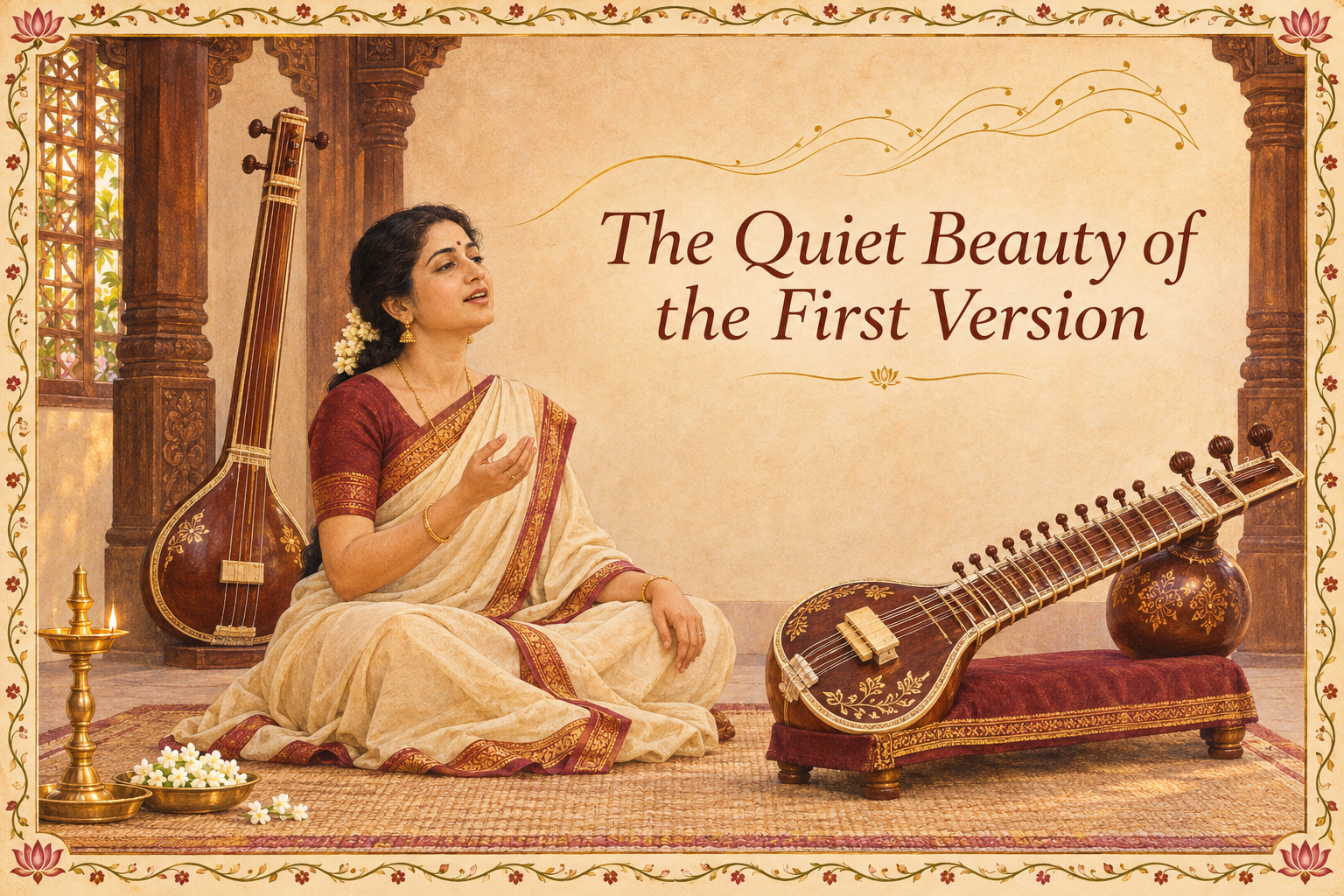
Sometimes the simplest statement of a melody is the one that stays with us. A singer offers a short line, its shape clear enough to hold in memory. Then the line grows: a turn becomes more intricate, a phrase reaches higher, a syllable carries a longer sweep of sound. We enjoy the unfolding richness while still remembering that first, unhurried version.
In Carnatic music, sangatis are melodic variations associated with a line of a composition. They can give a familiar passage increasing breadth and intricacy while preserving its identity. These variations belong to the composition’s performed tradition; some have been contributed by later musicians and become part of the versions passed down through different teaching lineages. mtosmt.org
For the listener, this creates a pleasure rather like watching a drawing acquire detail. The initial outline remains perceptible as further curves appear. We can follow what changes because something recognizable stays within reach.
But must the most elaborate version always be our favorite?
A modest phrase can have a particular intimacy. We hear its proportions easily: where it rises, where it hesitates, where it comes to rest. Later variations may bring excitement or intensity, yet the opening has already given us something complete enough to love. Its directness has an expressive value of its own.
At SRSKA, this is a lovely thought to carry into our appreciation of Carnatic vocal music. Students and families can admire sophisticated artistry while also cherishing a beautifully shaped, uncluttered line. Musical depth can reveal itself through the care given to just a few sounds.
Our Hindustani sitar tradition offers its own occasions for appreciating economy: a measured pluck, a small movement of pitch, a phrase whose ending arrives exactly when the ear needs it. The musical conventions differ, but we can bring the same attentive curiosity to how much expression a short gesture contains.
As a Carnatic composition unfolds through its variations, we may find ourselves holding two impressions together—the growing energy of the present passage and the gentleness of its first appearance. Each gives the other meaning.
Later, away from the concert, perhaps it is the opening that returns to us. We hum its few notes while putting away a cup. The elaborate passages have left their impression, but this small, singable shape keeps us company.
On the calendar
- December 12, 2026, 9:30 AM–noon — New York: Kedar Naphade’s harmonium workshop, Chhandayan Center, 269 West 39th Street; exploring the instrument’s solo and accompanying roles. Chhandayan Center for Indian Music
- December 14–19, 2026 — Gwalior, India: Tansen Music Festival, organized by Madhya Pradesh’s Department of Culture; the official tourism listing names Behat village as the venue. incredibleindia.gov.in